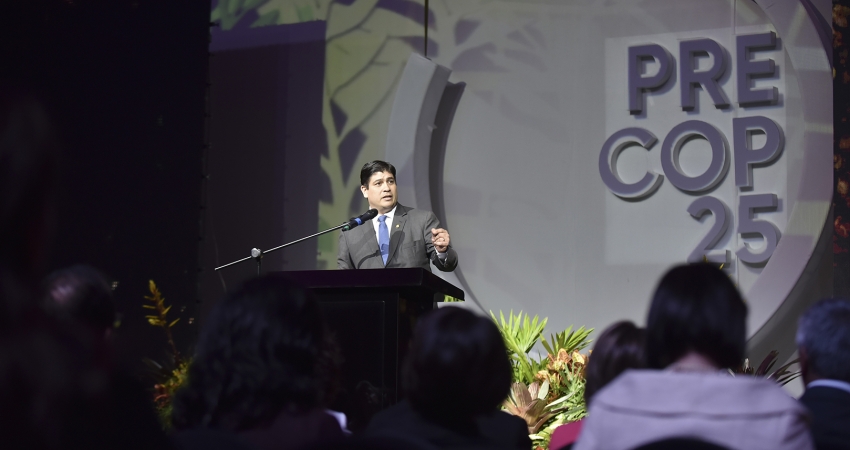
With the implementation of the National Decarbonization Plan (2018-2050), Costa Rica will receive benefits -especially savings- amounting to US$19.5 billion. This was stated by the President of the Republic of Costa Rica, Carlos Alvarado Quesada, during his inaugural speech at PreCOP25.
This week, the Central American country is hosting the preparatory meeting for the 25th Conference of the Parties to the United Nations Framework Convention on Climate Change (COP25), which will be held in Santiago, Chile, from December 2 to 13.
The study referred to by the Costa Rican president was prepared by the University of Costa Rica, the Inter-American Development Bank (IDB), the Rand Corporation, the Royal Institute of Technology in Stockholm (Sweden) and the Tecnológico de Monterrey (Mexico).
The objective of this research was to analyze the impact on the Costa Rican economy of the implementation of the National Decarbonization Plan, presented in February 2019, which includes goals in 10 thematic areas such as public, private and cargo transportation, as well as sustainable and clean production in industry, smart cities and digitalization, waste management, agriculture, livestock and forestry resources.
“By measuring the first three axes of the Plan until 2050, related to public transportation, private transportation and freight transportation, the researchers” findings indicate that the country will obtain a net benefit of 19.5 billion dollars by making the changes indicated therein," the President said.
He went on to explain that these figures are obtained by adding several items together. For example, in terms of electricity infrastructure to enable the electrification of the transportation sector, the country must invest almost US$6 billion, but will obtain a benefit of US$11.1 billion as a result of lower operating costs.
“There we have a first gain, which we could call direct, for 5.2 billion dollars net by 2050,” explained Alvarado and added: “To this we must add benefits in terms of health, higher productivity due to lower dams and avoided accidents, which represent a total of 14.3 billion dollars by 2050, according to experts” projections.".
“The bottom line is clear: environmental ambition is not only ethically right for present and future generations, it is cost-effective. Each country will make its own estimates, in light of its experiences and circumstances, but the decarbonization laboratory called Costa Rica can prove that ambitious decarbonization goals are achievable without harming sustainable, human and economic development,” the president emphasized.
We share with you this photo gallery prepared by Yannina Cordero, fellow of the Latin American Media Coverage Program COP25, on the inaugural echo of the Pre-COP25. The Latin American COP25 Media Coverage Program is an effort coordinated by LatinClima, Journalists for the Planet, The Stanley Foundation and the Regional Network on Climate Change and Decision Making - UNITWIN Program of UNESCO, with the support of Iniciativa Climática de México.