Would you prefer to listen to it? Play the audio here
The challenge is to turn green financing opportunities into priority investments for the country's development.
Marian Buraschi – Partner and Director of Libélula
Latin America and the Caribbean have an extraordinary opportunity: to transform their natural wealth and development needs into investments that generate growth, jobs, and resilience. However, to take advantage of this opportunity, we must reframe the question: instead of focusing on how much climate finance is still needed, what are we doing to mobilize the funding that already exists to address our country’s top priorities?
The recent first Latin American meeting Green Finance and Innovation, organized by the UNDP LAC Facility and the LEDS LAC platform and held in Panama last week, led to an important insight: the financing gap is not necessarily one of resources, but rather one of coordination, capacity, and projects that are ready to receive investment.
According to ECLAC figures, the region requires climate investments equivalent to between 3.7% and 4.9% of its annual GDP by 2030, while recorded climate financing accounted for just 0.5%. This gap requires not only mobilizing more capital but also using it more effectively.
We’re not starting from scratch. In Uruguay, the Renewable Energy Innovation Fund (REIF) combines concessional resources, bank loans, and technical assistance. As of 2025, with US$1.45 billion in initial capital, it had approved 17 loans for 15 innovative micro and small enterprises and mobilized a portfolio of US$1.425 billion in private investment. In Panama, instruments such as parametric insurance and contingent financing are protecting public finances and the population against disasters.
These experiences, along with initiatives identified in 12 Latin American countries, show that there is no one-size-fits-all solution. The challenge is to adapt financial solutions to the needs of each region and leverage regional lessons learned and South-South cooperation to make faster progress.
In this scenario, development banks must take on an even more strategic role. It is not enough to simply grant loans: we need institutions capable of reducing risks, offering guarantees, attracting private capital, and supporting project development. According to an OECD analysis, about 45% of the interactions between national development banks and international institutions include climate or green components, but only about 5% consists of technical support. There lies a concrete opportunity: to invest more in project preparation and strengthen coordination among stakeholders to expand access to financing and multiply its impact.
For Peru, this means shifting from a list of needs to a portfolio of investment opportunities. Water security, resilient agriculture, the circular economy, and nature-based solutions require robust studies, viable business models, managed risks, and measurable results.
To achieve this, it will be essential to coordinate the government, development banks, businesses, international cooperation, and foreign investment. Identifying strategic national programs with portfolios of priority projects, strengthening technical capacities, and leveraging instruments that attract private investment will make it possible to connect available resources with opportunities that have not yet materialized.
Peru can learn from successful initiatives already in place in the region. One example is the Panama Canal, which has invested approximately US$$6 million annually for 25 years in managing its watershed, recognizing that protecting water also means protecting the continuity of its business, which generates trillions of US$$ annually. What opportunities could we create if we incorporated this same long-term vision into our investments?
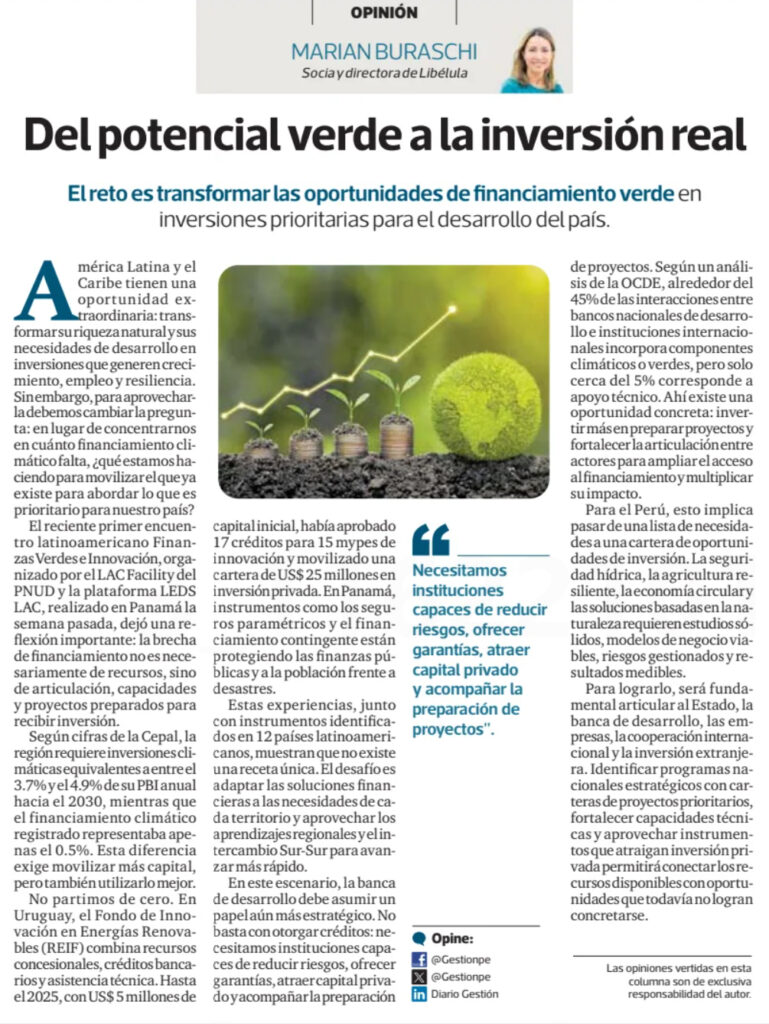
Column published in the Diario Gestión