An industry capable of contributing S/. 14 billion to the GDP and generating 300,000 jobs if formalized and scaled up.
Marian Buraschi
Partner and Director of Libélula
Would you prefer to listen to it? Play the audio here
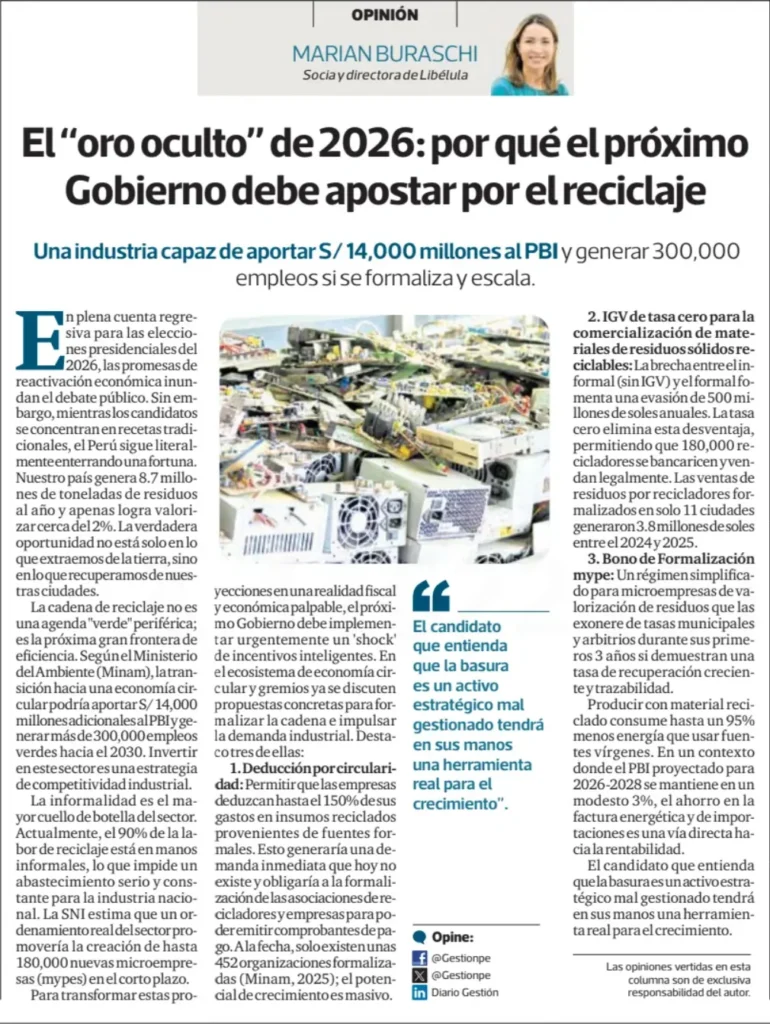
In the countdown to the 2026 presidential elections, promises of economic recovery are flooding the public debate. However, while the candidates focus on traditional recipes, Peru continues to literally bury a fortune. Our country generates 8.7 million tons of waste per year and only manages to recover about 2%. The real opportunity lies not only in what we extract from the earth, but in what we recover from our cities.
The recycling chain is not a peripheral «green» agenda; it is the next great efficiency frontier. According to the Ministry of Environment (MINAM), the transition to a circular economy could contribute an additional S/. 14,000 million to the national GDP and generate more than 300,000 green jobs by 2030. Investing in this sector is not only an environmental issue, it is an industrial competitiveness strategy.
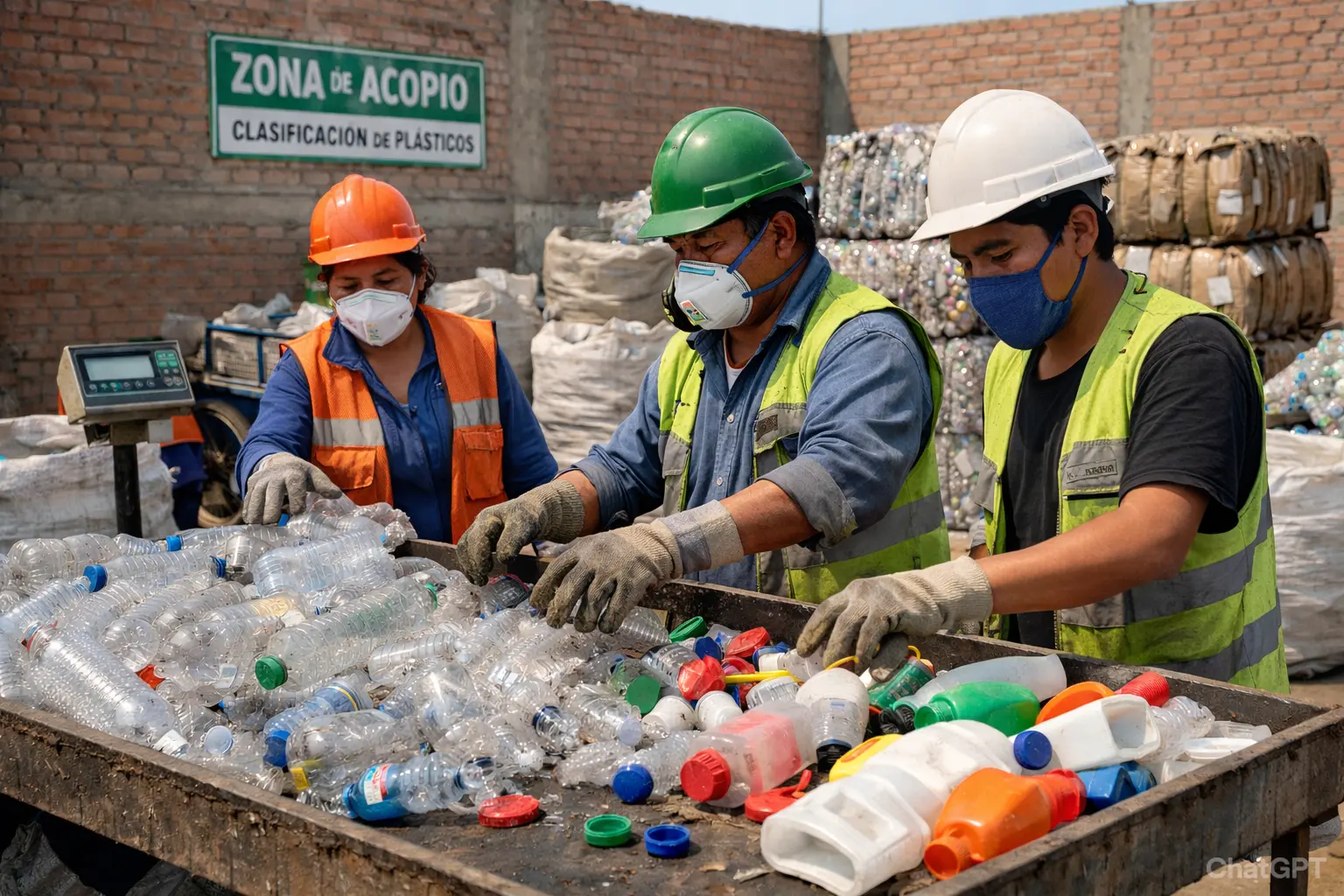
Informality is the sector's biggest bottleneck. Currently, 90% of the recycling work is in informal hands, which prevents a serious and constant supply for the national industry. The National Society of Industries (SNI) estimates that a real order in the sector would promote the creation of up to 180,000 new micro-enterprises (MYPEs) in the short term.
To transform these projections into a palpable fiscal and economic reality, the next government must urgently implement a ‘shock’ of smart incentives. In the circular economy ecosystem and trade associations, concrete proposals are already being discussed to formalize the chain and boost industrial demand. I highlight three of them:
- Circularity Deduction: Allow companies to deduct up to 150% of their expenditures on recycled inputs from formal sources. This would generate an immediate demand that does not exist today and would force the formalization of recyclers' associations and companies in order to be able to issue payment vouchers. To date, there are only 452 formalized organizations (MINAM, 2025); the potential for growth is massive.
- Zero-rate IGV for the commercialization of recyclable solid waste materials: The gap between the informal (without IGV) and the formal sector encourages an annual evasion of 500 million. The zero rate eliminates this disadvantage, allowing 180,000 recyclers to bank and sell legally. Waste sales by formalized recyclers in just 11 cities generated 3.8 million soles between 2024 and 2025.
- MSE Formalization Bond: A simplified regime for waste recovery microenterprises that exempts them from municipal taxes and excise duties during their first 3 years if they demonstrate an increasing recovery rate and traceability.
Producing with recycled material consumes up to 95% less energy than using virgin sources. In a context where the projected GDP for 2026-2028 remains at a modest 3%, saving on energy and import bills is a direct route to profitability.
The candidate who understands that waste is a mismanaged strategic asset will have in his or her hands a real tool for growth. It is time to stop seeing recycling as a municipal cleanup responsibility and start seeing it for what it is: a smart investment for the nation. In 2026, the vote should be for whoever dares to unearth the potential of our own economy.
Published in the Diario Management