Companies need the Sustainable Development Goals (SDGs) because they offer a sustainable growth strategy for business and for the global economy. Far from seeing it as a regulatory framework, it should be seen from a strategic point of view because there are many business opportunities in the SDGs.
Business opportunities in the SDGs: a global framework for transformational change
The SDGs have several ambitions, such as ending poverty, reducing inequality and addressing climate change, among others.
The 17 goals and 169 specific targets of the 2030 Agenda for Sustainable Development set the world's sights on addressing the most critical environmental, social and economic issues facing us today.
The United Nations Department of Economic and Social Affairs (DESA), which leads on business opportunities in the SDGs, is unequivocal that action by governments, civil society and the private sector is crucial to achieving the ambitions.
Beyond moral responsibility, there are real business opportunities in the SDGs.
The Business for 2030 initiative highlights that the ambition of the 2030 Development Agenda creates a great opportunity for the private sector to demonstrate the central role it plays in sustainable development and human prosperity.
Far from being a dry, compliance-only regulatory framework, business opportunities in the SDGs are beginning to intensify.
A UN report found that 82 out of 100 companies demonstrated commitment to the SDGs in their 2016 annual reports, either through explicit statements on the goals or actions underpinning them.
Where are there more business opportunities?
SDG 13 (Climate Action), SDG 3 (Good Health) and SDG 10 (Reduced Inequalities) were the top priorities for business opportunities in the SDGs with the focus varying by sector.
Business opportunities in the SDGs: a global framework for transformational change
Business opportunities in the SDGs will continue to grow.
Some companies are already recognizing the need to operate in stable economies as, conversely, growing inequality, poverty, climate and water risks are threats to almost any business model.
The biggest risks for businesses
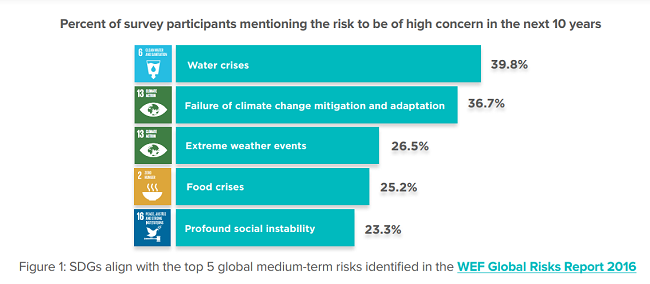
The top five medium-term risks highlighted in the World Economic Forum's 2016 Global Risks Report align with the SDGs. If companies are to protect their future supply chains and markets, it is important to work in alignment with the 17 SDGs.
Percentage of survey participants citing risks as a major concern in the next 10 years
5 business opportunities in the SDGs
1. 12 billion dollar market opportunity
The SDGs promise significant financial rewards for companies that invest in delivering innovative solutions and transformational change.
According to a Business Commission report, achieving the SDGs could create 380 million jobs and help unlock at least $12 trillion in business opportunities by 2030.
This favors companies that do see business opportunities in the SDGs.
A study of 12 companies, including Siemens, Toshiba, DuPont and Philips, by Conference Board found that between 2010 and 2013, sustainable product revenues grew at six times the rate of overall company revenues.
Unilever also has brands that have integrated sustainability into both their purpose and products and are growing 30% faster than the rest of the brands.
Considering the business opportunities in the SDGs, it is not surprising that companies such as L'Oréal and Philips are undergoing major sustainability drives, or that SC Johnson has acquired two green cleaning brands, Method and Ecover.
2. Customer trust and loyalty
There is growing evidence that consumers are more aware of corporate sustainability and are prepared to pay for sustainable products.
In a 2015 survey of 30,000 consumers in 60 countries, 66% of respondents said they would be willing to pay more for sustainable products, with factors including the environment, packaging, price, marketing and claims related to organic or health and wellness credentials.
81% of Millennials believe that businesses have a key role to play in achieving the SDGs; according to them, companies must demonstrate a clear and credible commitment to sustainability if they want to maintain customer and employee loyalty.
Lower costs due to more efficient use of resources.
By 2030, as renewables displace fossil fuels, it is expected to be increasingly cheaper to choose wind and solar power than coal or gas in countries such as India, the UK and Denmark.
Under RE100, 124 of the world's leading companies, including IKEA, H&M and Google, have committed to using 100% of electricity from renewable sources in the coming years.
In addition to bolstering corporate reputation, investing in renewable energy now protects against fluctuating fossil fuel prices and ensures a stable energy supply for decades to come.
Companies are also investing in more efficient water management practices, as well as innovation around circular design methods, which can reduce waste and even provide new resources and revenue.
4. Reduced risk
Companies cannot succeed in a world of environmental, economic and social instability.
Addressing critical issues such as climate change, biodiversity loss, poverty and gender equality with market solutions are business opportunities in the SDGs.
Companies that actively manage and plan for climate change, one of the most urgent SDGs to address, have a 18% higher ROI than companies with lower scores, indicating that a proactive approach to managing risk pays off and that there are huge business opportunities in the SDGs.
5. Long-term value in new markets
In addition to ensuring a prosperous and stable future for the planet, the SDGs provide a framework within which companies can secure their own growth.
This can be done by increasing investments in new markets with significant growth potential.
With the indicators provided by the SDGs, companies can report progress to stakeholders and differentiate their performance from the competition.
This can even serve as a way to foster long-term partnerships with governments in companies' markets or supply chains, improving access and operational flexibility within these markets.
Companies that integrate the SDGs into their corporate strategies already have a clear advantage over competitors.