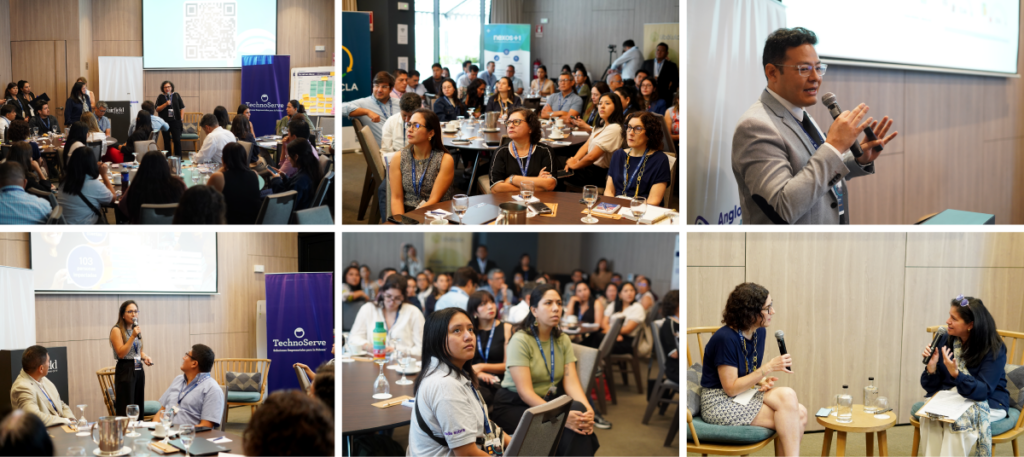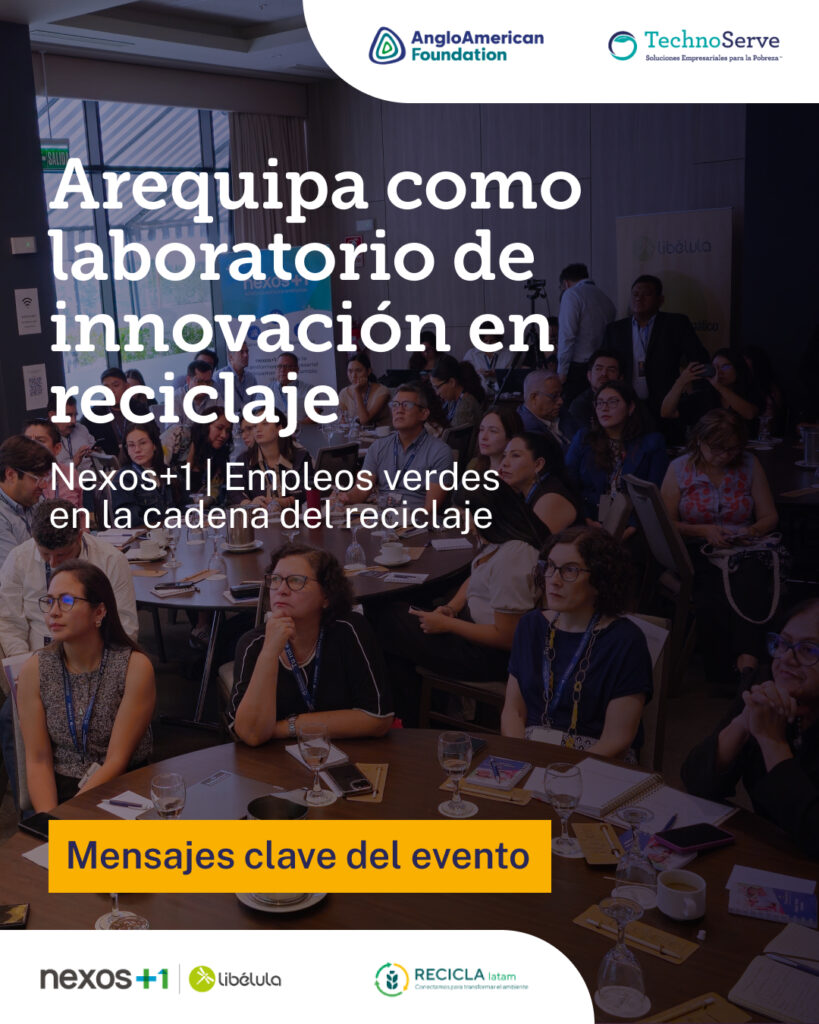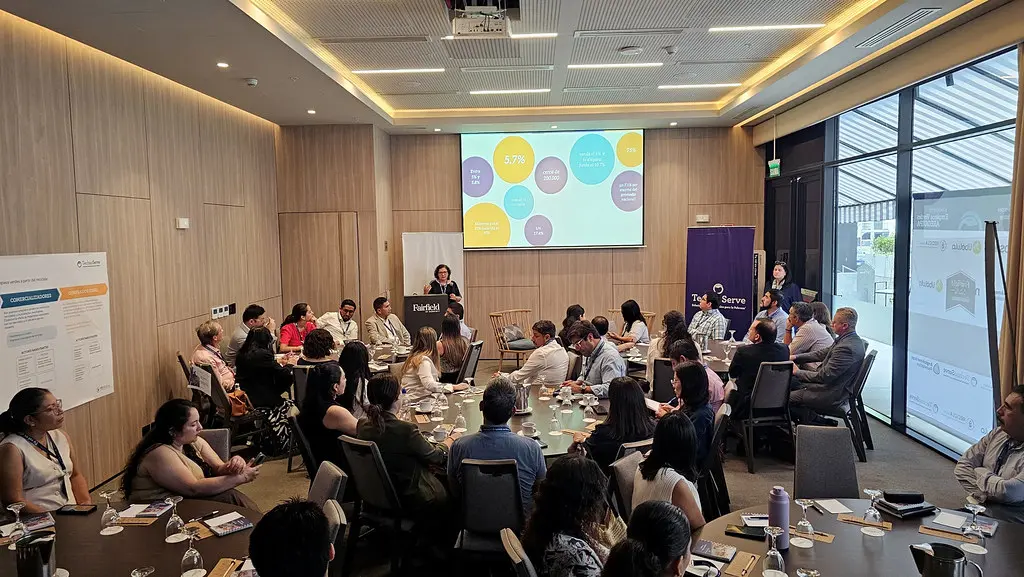
Nexos+1 : Green jobs in the recycling chain brought together more than 60 actors from the public, private, financial and cooperation sectors to address one of the country's most urgent challenges: how to close gaps and generate decent employment through recycling.
From the beginning of the meeting -driven by Anglo American Foundation y TechnoServe, together with Recycle Latam y Dragonfly- one idea became clear: recycling is not only an environmental issue, but a concrete economic opportunity that is not yet being fully exploited.
In this context, Arequipa is positioned as a key case. As the fourth most populated region in Peru and a strategic node in the south, it concentrates ideal conditions for piloting solutions that can be scaled nationally.
Arequipa: where results are already being generated
According to estimates based on data from MINAM (SIGERSOL), the region generates about 340,000 tons of waste per year, but only about 2% is recycled. This gap reflects both a challenge and an opportunity to boost the local economy.
According to the results of the first cohort of the project, concrete progress was made, such as the graduation and certification of 27 participants in the business acceleration program in alliance with the Universidad Católica de Santa María, the strengthening of the capacities of 117 people, emphasizing work with women and young people, the generation of 19 strategic alliances, and the sensitization of more than 15,000 homes and businesses, as well as 8,500 students, on recycling and environmental education. Progress was also made in the analysis of public policies aimed at strengthening the recycling sector and its articulation with the green jobs agenda, with the support of Libélula.
These results demonstrate that, with the right support, recycling can become a real source of income and development.
A structural challenge that requires articulation
According to MINAM (2019), nationwide, more than 500,000 people depend on recycling, but a large part of the chain continues to operate in conditions of informality, low productivity and limited coordination.
During the event, participants agreed that the problem is not the lack of activity, but rather the disconnection between actors, the lack of adequate financing and the barriers to formalization.
These gaps especially affect young people and women, who face greater difficulties in accessing decent employment in the sector.
Three priorities to activate the potential of recycling
Based on the collaborative work in Nexos+1, three key fronts were identified:
- Progressive formalization
Adapt processes to the reality of the sector to facilitate the transition to more formal schemes. - Market dynamization
Improve the connection with industry, reduce dependence on intermediaries and optimize logistics. - Access to financing
Develop instruments that respond to the characteristics of the sector and reduce investment barriers.
The Arequipa experience shows that it is possible to move towards a more inclusive, articulated and profitable chain. The challenge now is to scale up these solutions, consolidate alliances and translate the lessons learned into concrete policies and actions.
The message of Nexos+1 is clear: recycling in Peru is not a problem to be solved, but an opportunity to be activated.