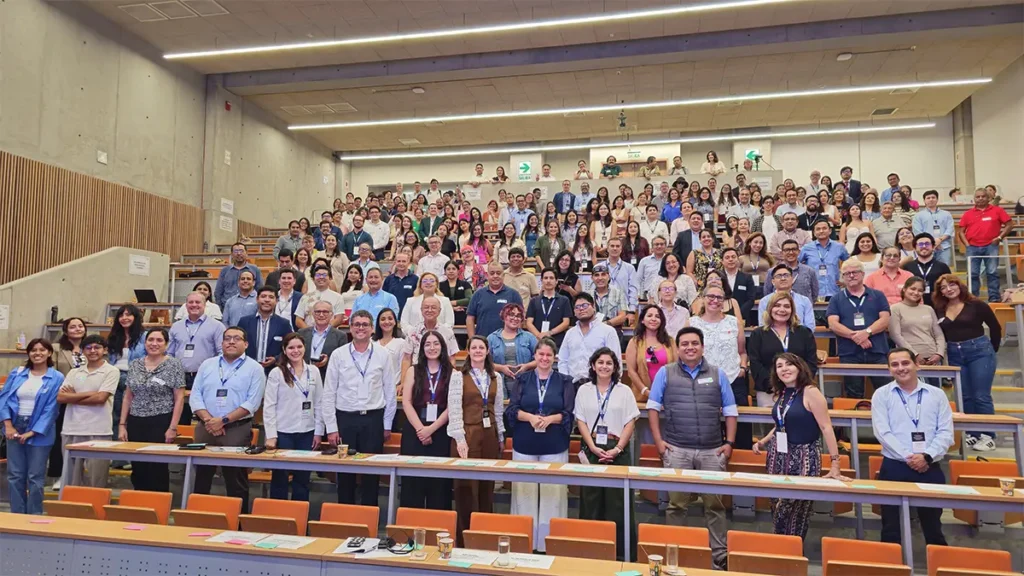
Preparing Latin American companies to increase their resilience and competitiveness in a world in the process of decarbonization was the main goal of nexos+1 - Forum Latam 2023, event developed by Libélula for the eighth consecutive year, which brought together more than 1,110 participants from companies in Latin America and the Caribbean, and was held on June 21, 22 and 23.
The event included plenary sessions, talks, panels and workshops that focused on the new challenges and opportunities that climate change is generating for companies, such as adaptation and climate risk management, the impact on biodiversity, energy transition, emissions in investment portfolios and in the value chain, among other topics.
Pia Zevallos, general manager of Libélula, indicated that since 2015 when COP21 took place, 198 countries pledged to make the necessary efforts to prevent the planet's temperature from rising by a maximum of 2°C, while striving for a maximum of 1.5°C. Since that time, companies have implemented various actions, including the growth of investment in renewable energies, the development of carbon pricing schemes, resilience in infrastructure, livestock and agriculture, technological innovation and climate awareness, all of which are key factors in reducing greenhouse gas emissions.
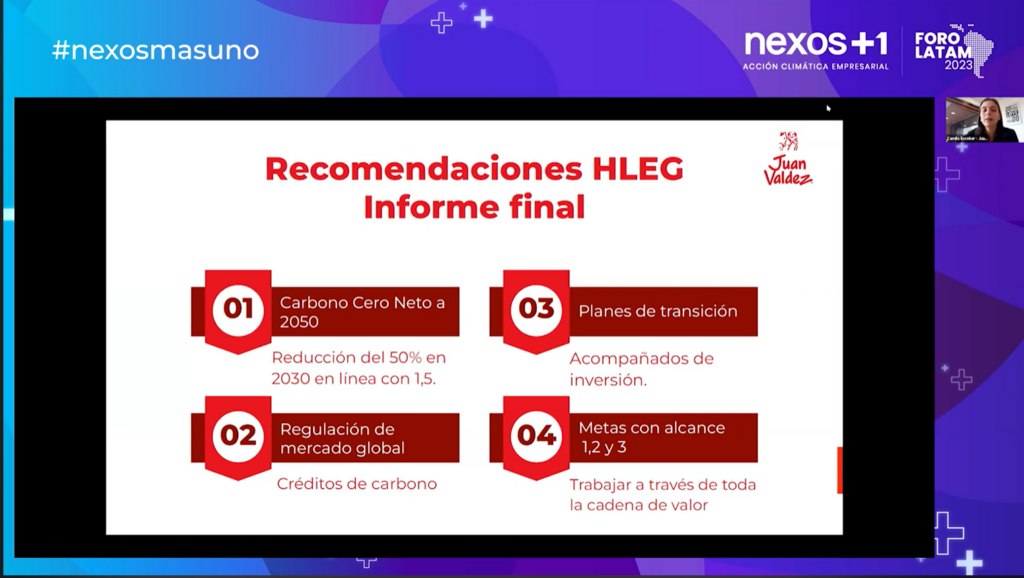
The Forum was also a space to learn about the experience of different companies and leaders that are making sustainability part of their business strategy. Camila Escobar, CEO of Juan Valdez Café, and part of the High Level Expert Group 2022 of the UN, said that the private sector faces two major challenges: greenwashing and untrue or very optimistic announcements on decarbonization. He also gave some recommendations in the context of sustainability that companies should follow, among which the following stand out: to be carbon neutral by 2050 and this requires a 50% reduction in emissions by 2030; to implement transition plans accompanied by investment, include SMEs in the transition, and have a regulatory framework with commitments.
“Sustainability must be part of the business strategy, you need a culture and awareness from the CEOs to the people who are in operation.», Escobar pointed out.
Climate adaptation
Adapting to climate change involves taking decisive action to increase the organization's resilience to climate change. the effects of climate change, both current and future. For this reason, during the Latam Forum, the following panel was developed Climate Adaptation: a strategy for business resilience, The event was attended by Marcia Toledo, Director of Adaptation and Resilience for the Race to Resilience and Paula Durán, director of sustainability at Corficolombiana, a leading investment company in Colombia.
“It is important for the private sector to start investing in climate adaptation, as it complements the government. Being the engine of transition to new markets, green jobs and social protection.”, said Toledo.
Durán explained that “Physical and transitional risks should be identified, prioritized and quantified, that way we see how it affects profitability and allows companies to take action”he said.
Biodiversity and regeneration
The forum also discussed the value of biodiversity in business and its relationship with climate action. Estefania Michel, Sustainable Finance Manager, MX and Latin America HSBC stressed that companies must localize their relationship with nature.
“Nature and climate are two sides of the same coin, and this nexus will give a more global and broader picture. While there is some regulation that mandates titling and reporting on biodiversity, the vast majority of small and medium-sized companies (90% of the economy) still do not prioritize these issues.”, he explained.
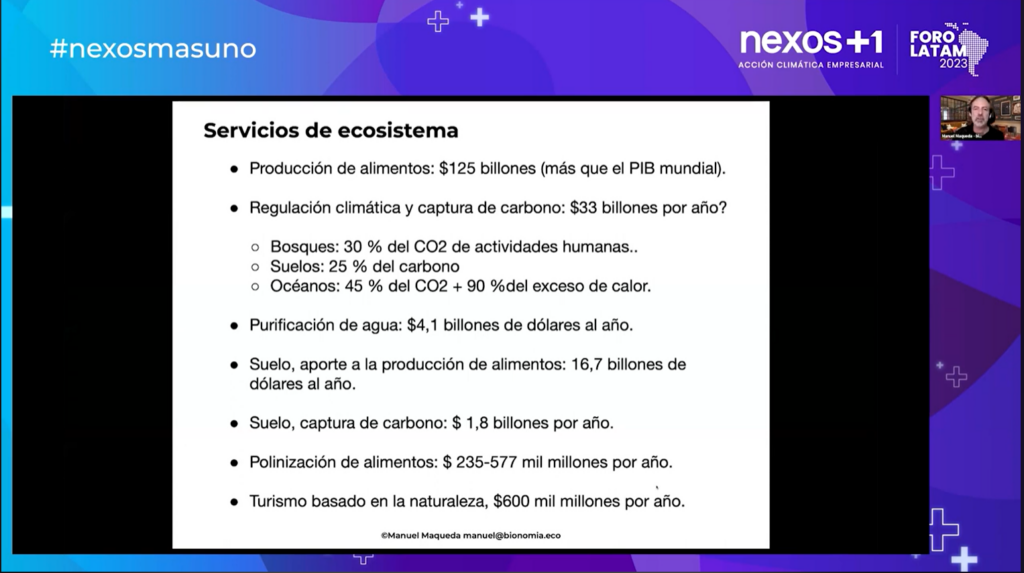
One of the most important issues in which the private sector is developing actions is circularity. Manuel Maqueda, CEO of Bionomics and professor at Harvard University, argued that circularity and regeneration are not about acquiring new knowledge, but about changing the way actions are performed, for which it is important to think and act differently.
“The regenerative economy is one that restores the capacity of the biosphere.
The goal is to separate the idea of value from resource extraction. It's about designing to renew things as we are currently managing them.”, he explained.
Climate action priorities
During the second day of the forum, Alex Perry, Patagonia's general manager for Latin America, presented a roadmap that any company and individual can follow to implement sustainability as part of their actions and thereby contribute to addressing climate change.
- Know the impact and have a reduction plan.
- Invest in people and communities, especially those who will find the solutions to climate change.
- Use the corporate voice.
Precisely, to understand the importance of transparency, during the event also took place the panel The Carbon Neutrality Mirage, in which Chris Zink, VP Carbon Finance of Conservation International stated that “it is important that companies are able to demonstrate that their actions are demonstrable and that the purchase of offsets are verifiable. Accountability is essential to avoid greenwashing and ensure that carbon neutrality is more than a marketing label.” Rebeca Lima, CDP's executive director, complemented that “It's important that there is regulation and guidance for companies because the carbon market is complex.".
For example, companies such as IKEA seek to be 100% carbon neutral by 2030, and therefore all the products they manufacture and design must meet 5 attributes: low price, functionality, form, quality and sustainability. Bernardita Correa Díaz, sustainability leader Chile, Peru and Colombia at IKEA, explained that as they are aware that they use 1% of the world's wood, this must be recycled or certified, and they also use organic and low-consumption cotton. “We have many products that are developed by communities or social entrepreneurs, who promote well-being».», he emphasized.
Rodrigo Barrios, climate change manager of TESCO, presented the Planet Plan that is being developed in the organization, which consists of different processes among which they highlight the prioritization of decarbonization and sustainability.
Thus, IKEA and TESCO are examples of leading companies that are addressing the challenge of managing their emissions and value chain impacts.
Energy efficiency for all
Juan Antonio Rozas, general manager of Statkraft, moderated the panel “Green Light for the Energy Transition”, in which he spoke about the importance of companies prioritizing the energy transition to renewable energies, in order to ensure their resilience in the future.“Statkraft each year reports an analysis of the state of the energy transition in the world today until 2050, the analysis shows that the energy transition must be accelerated, where electrification and energy efficiency must be two key pillars,” he explained.
Sany Rodriguez, DP World's Director of Safety and Environment, commented that the company's operations are based on energy use, and since 2015 with the Paris agreement they launched their commitment, carbon neutral by 2030 and net zero by 2050..
“Sustainability is not only about wanting something better for future generations, it's also about influence. You have to set a good example for the environment. It is about infecting companies with what is done in the value chain and in the logistics sector. Actions should not only be for business, they should be done for values and future generations”, he concluded.
Cecilia Rabitsch, vice president of environmental affairs and sustainability at Compañía Minera Condestable, said that Condestable is a Peruvian 100% company, and the transitional change is not related to its international standards but a decision by senior management. “The reason was that not only transnational companies should have commitments on sustainability. A first challenge compared to other transnational companies is financing, but it was achieved based on the business,” he said.
With the information provided by the different companies, Libélula and nexos+1 will continue to generate spaces that allow the visibility of tangible and demonstrable actions that inspire the private sector to increase its climate ambition and manage its impacts and risks in order to achieve a prosperous and low-carbon Latin America.