From data engineering to financial resilience: how AI-based decisions optimize assets and protect EBITDA in the face of climate risk.
Marian Buraschi
Partner and Director of Libélula
Would you prefer to listen to it? Play the audio here
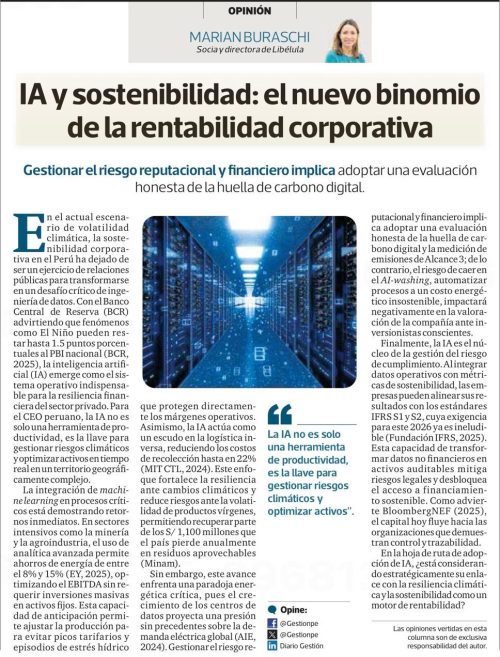
In the current scenario of climate volatility, corporate sustainability in Peru is no longer a public relations exercise but a critical data engineering challenge. With the Central Reserve Bank of Peru (BCRP) warning that phenomena such as El Niño could subtract up to 1.5 percentage points from the national GDP (BCRP, 2025), Artificial Intelligence (AI) emerges as the indispensable operating system for the financial resilience of the private sector. For the Peruvian CEO, AI is not only a productivity tool, it is the key to manage climate risks and optimize assets in real time in a geographically complex territory.
The integration of Machine Learning in critical processes is demonstrating immediate returns. In intensive sectors such as mining and agribusiness, the use of advanced analytics enables energy savings of between 8% and 15% (EY, 2025), optimizing EBITDA without requiring massive investments in fixed assets. This anticipatory capability allows production to be adjusted to avoid tariff peaks and water stress episodes that directly protect operating margins. Likewise, AI acts as a shield on reverse logistics, reducing collection costs by up to 22% (MIT CTL, 2024). This approach strengthens resilience to climate change and reduces risks in the face of virgin product volatility, making it possible to recover part of the S/ 1.1 billion that the country loses annually in usable waste (MINAM).
However, this progress faces a critical energy paradox, as the growth of data centers projects unprecedented pressure on global electricity demand (IEA, 2024). Managing reputational and financial risk involves adopting an honest assessment of the digital carbon footprint and Scope 3 emissions measurement; otherwise, the risk of AI-washing, automating processes at an unsustainable energy cost, will negatively impact the company's valuation with conscientious investors.
Finally, AI is at the heart of compliance risk management. By integrating operational data with sustainability metrics, companies can align their results with IFRS S1 and S2 standards, which are already required by 2026 (IFRS Foundation, 2025). This ability to transform non-financial data into auditable assets mitigates legal risks and unlocks access to sustainable financing. As BloombergNEF (2025) warns, capital today flows to organizations that demonstrate control and traceability.
In the AI adoption roadmap, are you strategically considering its link to climate resilience and sustainability as a profitability driver?
Published in the Diario Gestión.