Would you prefer to listen to it? Play the audio here
The next administration must anticipate emergencies, protect essential systems, and make climate preparedness a strategy for investment and regional development.
Marian Buraschi - Libélula Partner and Director
Every new government needs time to get settled. This time, the weather won’t give it that time. The new administration will take office on July 28, and its first 90 days will coincide with the rainy season and the period of greatest risk associated with El Niño.
Those 90 days should be used to safeguard the country's economic stability by focusing on three priorities.
The first is to manage risk before dealing with an emergency. By the 30th, the government should have a map of climate threats and critical infrastructure in order to determine which bridges, roads, waterways, water treatment plants, and hospitals cannot be allowed to fail.
Each critical asset must have a designated person in charge, a budget, and a contingency plan. If a watershed is placed on alert or a community is at risk of being cut off, the response must begin before the disruption occurs, with resources and coordination among the national government, regions, and municipalities.
The second priority is to protect the systems that sustain life and the economy. The country must prepare for simultaneous emergencies: floods, water stress, droughts, and wildfires, as well as road closures, public health outbreaks, and displacement.
By day 60, food and medicine storage facilities, cold storage centers with backup power, alternative routes, shelters, and hospitals with independent water and electricity supplies should be in place.
Food security encompasses production, transportation, storage, and refrigeration. Protecting agricultural exports requires ensuring access to water, crop health, roads, ports, insurance, and working capital. A blocked road can drive up prices and cause a country to miss an export opportunity.
Energy security also requires foresight. Faced with a potential decline in hydroelectric generation, the immediate challenge is not to build new infrastructure, but to ensure the efficient operation of the electric power system and reduce the impact on energy costs.
The third priority is to turn training into jobs and regional investment. Work can begin quickly on the maintenance of drains, canals, and roads; the restoration of riverbanks; firebreaks; solar systems; and the refurbishment of warehouses.
Agriculture and fisheries account for jobs that are vulnerable to climate change: a drought, flood, or shift in species can jeopardize an entire growing season. Insurance, credit, and access to government procurement must be secured before the impact occurs, in order to sustain income and supply.
By day 90, the government should present a portfolio covering water security, green infrastructure, renewable energy, resilient logistics, and the circular economy, with mature projects and secured financing. A public-private partnership will be useful if it commits to investment, information sharing, and procurement.
The next administration should not be judged by how many plans it announces, but by what it has planned and implemented by day 90: protected critical infrastructure, strengthened essential systems, and a portfolio of projects ready for implementation.
The true measure of the next administration will not be how many announcements it makes, but how well it prepares us to face the future. The question is simple: Do we want to continue managing emergencies, or do we want to start building resilience and fostering development?
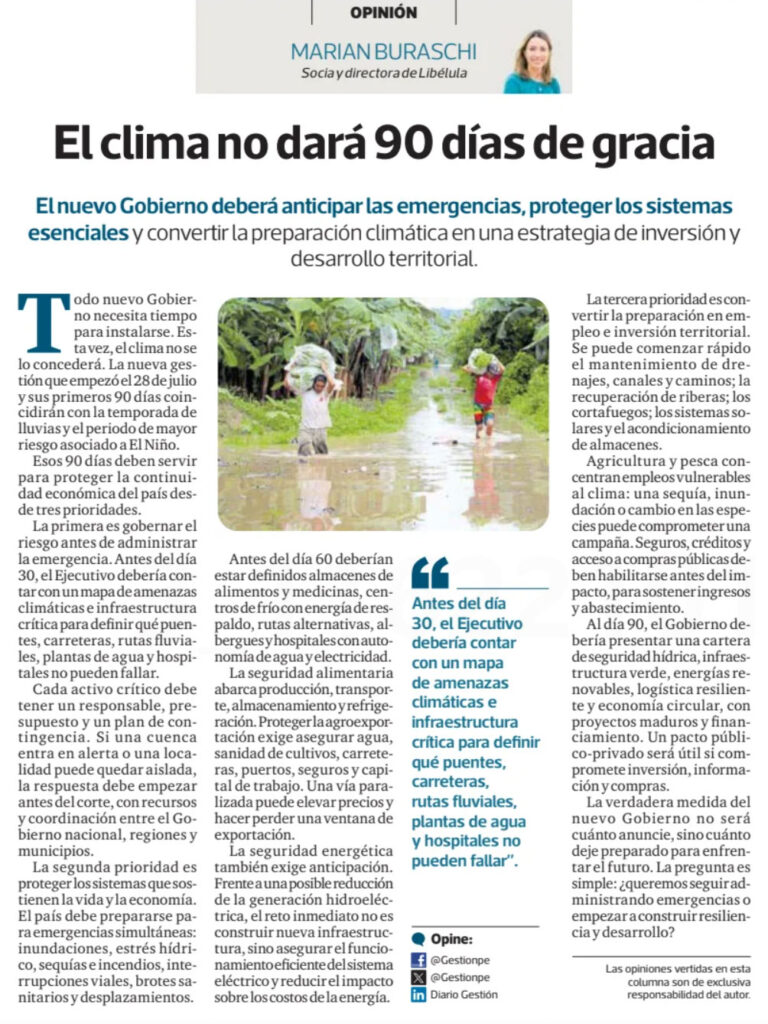
Column published in Diario Gestión (July 30, 2026)