
Would you prefer to listen to it? Play the audio here
The economy can affect revenue, costs, and assets. The challenge is to assess how much of the business is at risk.
Marian Buraschi - Libélula Partner and Director
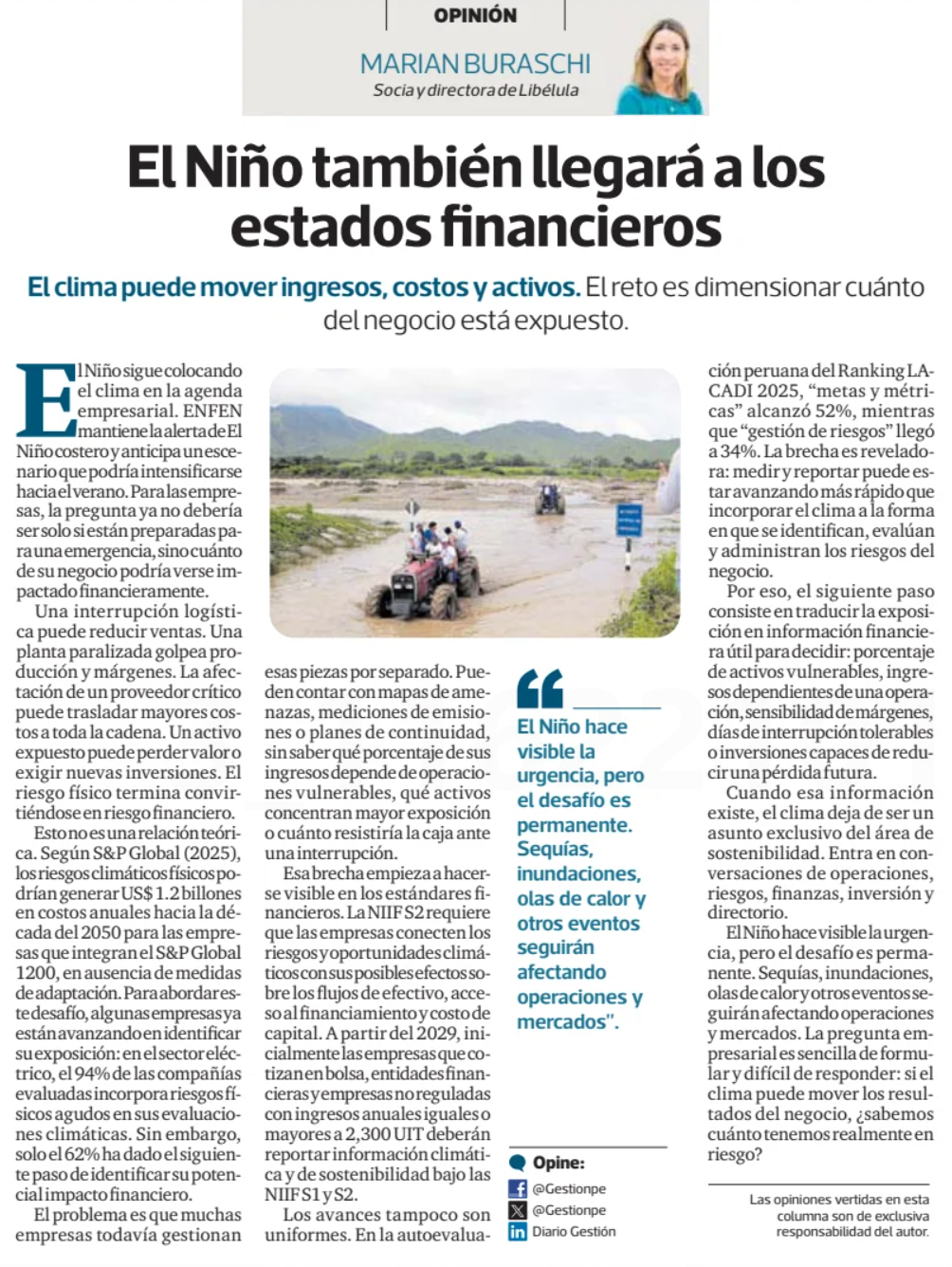
El Niño continues to keep the weather on the business agenda. ENFEN is maintaining its Coastal El Niño alert and anticipates a scenario that could intensify as summer approaches. For companies, the question should no longer be just whether they are prepared for an emergency, but how much of their business could be financially impacted.
A disruption in logistics can reduce sales. A shutdown at a plant hurts production and margins. A disruption affecting a critical supplier can pass on higher costs throughout the supply chain. An exposed asset may lose value or require new investments. Physical risk ultimately becomes financial risk.
This is not a theoretical relationship. According to S&P Global (2025), physical climate risks could result in annual costs of US$$1.2 trillion by the 2050s for companies in the S&P Global 1200 index, in the absence of adaptation measures. To address this challenge, some companies are already making progress in identifying their exposure: in the electric utility sector, 94% of the companies assessed incorporate acute physical risks into their climate assessments. However, only 62% have taken the next step of identifying their potential financial impact.
The problem is that many companies still manage these elements separately. They may have threat maps, emissions measurements, or business continuity plans, without knowing what percentage of their revenue depends on vulnerable operations, which assets are most exposed, or how long their cash reserves would last in the event of a disruption.
This gap is beginning to become apparent in financial standards. IFRS S2 requires companies to link climate risks and opportunities to their potential effects on cash flows, access to financing, and cost of capital. Starting in 2029, publicly traded companies, financial institutions, and unregulated companies with annual revenues of 2,300 UIT or more will be required to report climate and sustainability information under IFRS S1 and S2.
Progress is not uniform either. In Peru’s self-assessment for the LACADI 2025 Ranking, “goals and metrics” scored 52%, while “risk management” scored 34%. The gap is revealing: Measuring and reporting may be progressing faster than incorporating climate considerations into the way business risks are identified, assessed, and managed.
Therefore, the next step is to translate this analysis into financial information that can be used to make decisions: the percentage of vulnerable assets, revenue dependent on a particular operation, margin sensitivity, tolerable downtime in days, or investments capable of reducing future losses.
When that information is available, climate issues are no longer the exclusive domain of the sustainability department. They become part of discussions about operations, risk, finance, investment, and the board of directors.
El Niño highlights the urgency, but the challenge is ongoing. Droughts, floods, heat waves, and other events will continue to affect operations and markets. The business question is simple to ask but difficult to answer: If the climate can impact business results, do we know how much is actually at risk?
Column published in the Gestión Newspaper